The global housing sector faces a convergence of pressures: rapid urbanisation, acute material shortages, tightening carbon budgets, and consumers demanding faster delivery at lower cost. Modular houses — precision-engineered units manufactured in controlled factory environments and assembled on-site — have emerged as the most credible systemic response. This article examines the technical underpinnings, economic logic, environmental credentials, and logistical realities of modular construction, with particular reference to the product line developed by Shanghai Cymdin Industrial Co., Ltd.
"Modular construction is not a compromise — it is a methodological upgrade: more predictable quality, shorter lead times, and a materially lower environmental footprint than site-built equivalents."
1. What Is a Modular House? Definitions and Typology
A modular house is a dwelling constructed from three-dimensional volumetric units — modules — that are produced off-site in a factory and subsequently transported to a permanent location for installation. Each module is typically 60–95% complete on departure from the factory, with interior finishes, electrical rough-in, plumbing, and insulation already installed. On-site work is largely limited to foundation preparation, module craning, inter-module connection, and utility tie-in.
The terminology around off-site construction can be confusing. The table below clarifies the principal categories:
Table 1 — Taxonomy of Prefabricated Construction Methods
| Method |
Off-Site Completion |
Structural Form |
Typical Use Case |
| Volumetric Modular |
60–95 % |
3-D box units stacked/joined |
Residential, hotels, student housing |
| Panelised |
30–60 % |
Flat panels assembled on-site |
Single-family homes, low-rise |
| Container Conversion |
40–80 % |
ISO shipping container repurposed |
Compact residential, site offices |
| Hybrid / Pod |
50–70 % |
Volumetric pods within frame |
Bathroom/kitchen pods in larger builds |
| Traditional Site-Built |
0–5 % |
In-situ frame and masonry |
Full spectrum, conventional default |
Cymdin's modular building portfolio covers volumetric modular and container-conversion typologies, spanning residential villas to commercial facilities and emergency structures — a breadth of application that underscores the technology's adaptability.
2. Structural Engineering: Steel Frames and Load Pathways
The structural backbone of most modern modular houses is a cold-formed or hot-rolled steel frame. Steel offers an excellent strength-to-weight ratio, is dimensionally stable in factory conditions, and lends itself to robotic fabrication — all critical advantages when tolerances must be held to within ±2 mm across a 10-metre module.
2.1 Primary Structural System
Each module functions as a self-supporting structural unit. Corner posts transfer vertical loads from the roof through the wall framing to the floor chassis, which in turn bears on the foundation or on the module below in multi-storey stacks. The inter-module connection — typically a bolted steel bracket or purpose-designed splice plate — must transfer both vertical loads and horizontal shear forces induced by wind or seismic activity.
Cymdin's steel-frame modules are engineered to exceed seismic and fire-resistance performance benchmarks by approximately 30% compared with conventional timber-frame construction, achieved through the inherent ductility of structural steel and the application of intumescent coatings where required by local code.
2.2 Thermal Envelope and Insulation Strategy
Thermal performance is determined by the composite wall, floor, and roof assemblies. A high-performance modular envelope typically consists of an exterior cladding layer (fibre-cement board, aluminium composite panel, or pre-finished steel), a continuous air barrier, a mineral-wool or rigid-foam insulation layer (R-values from R-15 to R-40 depending on climate zone), a vapour-control layer, and an interior finish board. Factory installation of these layers under controlled humidity and temperature conditions is superior to site installation, where weather and labour variability introduce performance gaps.
Table 2 — Indicative Thermal Performance by Wall Assembly Type
| Wall Assembly |
Total Thickness |
R-Value (approx.) |
Typical Climate Zone |
| Steel stud + 75 mm mineral wool |
150 mm |
R-15 |
Tropical / subtropical |
| Steel stud + 100 mm PIR board |
175 mm |
R-22 |
Temperate |
| SIP panel, 150 mm core |
195 mm |
R-28 |
Continental / cool temperate |
| Double stud + 200 mm cellulose |
280 mm |
R-40 |
Sub-arctic / Passive House |
3. The Factory Production Process: From Raw Steel to Finished Module
The manufacturing sequence for a Cymdin modular unit follows a disciplined linear workflow across dedicated production bays inside a 5,800 m² facility at No. 66 Caoli Road, Fengjing Town, Jinshan District, Shanghai:
Factory Production Sequence
- Stage 1 — Steel Fabrication: CNC-cut members are welded into floor chassis and wall frames to tight dimensional tolerances.
- Stage 2 — Shell Assembly: Roof, wall panels, and floor deck are attached to the structural frame, creating the volumetric box.
- Stage 3 — MEP Rough-In: Electrical conduit, plumbing runs, HVAC ducting, and data cabling are installed and pressure-tested.
- Stage 4 — Insulation & Air Sealing: Cavity fill, rigid board, and membrane layers are applied and independently inspected.
- Stage 5 — Interior Fit-Out: Flooring, wall linings, joinery, sanitary ware, and fixtures are installed and snagged.
- Stage 6 — Quality Audit & Transport Prep: Each module is inspected against a 200-point checklist before protective wrapping and loading onto flatbed or container transport.
The result is a complete module ready for craning into position within 45 days of order confirmation — a production cycle that compresses what would traditionally be a 6–18-month site construction programme.
4. Comparative Cost Analysis: Modular vs. Traditional Construction
Cost is typically the primary decision variable for developers and owner-builders. The modular cost advantage is not universal — it is a function of scale, transport distance, and the local labour market — but the structural drivers are well understood.
Table 3 — Cost Driver Comparison: Modular vs. Traditional Construction
| Cost Driver |
Modular Construction |
Traditional Construction |
Net Advantage |
| Labour (per m²) |
Lower — factory workers are specialist, consistent |
Higher — variable skill, weather downtime |
Modular saves 20–35 % |
| Construction timeline |
30–45 days on-site |
6–18 months on-site |
Modular saves ~60 % |
| Material waste |
~10 % of material input |
~30 % of material input |
Modular saves 67 % waste |
| Finance carry cost |
Shorter draw period |
Long draw, high interest exposure |
Modular saves interest |
| Transport & logistics |
Higher — specialist freight required |
Lower — standard material deliveries |
Traditional advantage |
| Long-term maintenance |
Lower — factory quality, durable materials |
Higher — site variability, early defects |
Modular saves 15–25 % |
Cymdin's published data indicates an overall cost saving of 15–30% versus comparable traditional builds when modular units are procured at scale. These figures align with independent industry analyses from markets in Australia, Europe, and the United States — Cymdin's three primary export regions.
5. Sustainability and Green Building Credentials
The environmental case for modular construction rests on three pillars: reduced construction waste, lower embodied carbon through material efficiency, and superior in-use energy performance attributable to factory-quality air sealing and insulation.
Cymdin's prefabricated production method reduces construction waste generation by approximately 80% relative to traditional site builds — a figure consistent with the broader industry literature. Materials can be sourced in precise quantities, offcuts are recycled within the factory, and the controlled environment eliminates weather-related material damage. For projects targeting carbon-neutrality certifications (BREEAM, LEED, Green Star), this waste reduction contributes meaningfully to embodied-carbon scores.
The Circular House and Space Capsule House product lines extend the sustainability narrative further, incorporating provisions for rainwater harvesting, solar hot-water systems, and off-grid energy configurations — allowing deployment in locations without reliable grid connection.
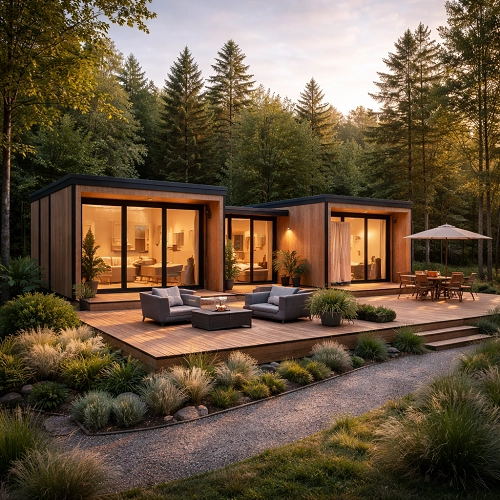
"Prefabricated production reduces construction waste by 80%; materials are designed for recyclability, directly supporting carbon-neutrality targets."
6. Application Spectrum: Where Modular Houses Are Deployed
One of modular construction's most compelling attributes is its scenario versatility. The same factory infrastructure and structural logic that produces a single-storey villa can, with module reconfiguration, deliver a multi-storey apartment block, a field hospital, or a remote workers' accommodation camp. The table below maps the primary application categories.
Table 4 — Modular House Application Matrix
| Sector |
Application |
Key Requirement |
Relevant Cymdin Product |
| Residential |
Single-family home, holiday villa |
Aesthetic customisation, comfort |
Modular House-1, Prefab Modular House-2 |
| Hospitality & Tourism |
Glamping pod, boutique cabin |
Design appeal, rapid deployment |
Apple Cabin, Space Capsule House |
| Commercial |
Office, retail kiosk, showroom |
Fast fit-out, scalability |
Modular Building |
| Industrial / Workforce |
Site offices, worker dormitories |
Durability, relocatability |
Container House |
| Emergency / Disaster Relief |
Temporary shelters, field clinics |
Speed of deployment, robustness |
Modular Building |
| Lifestyle / Wellbeing |
Home office, studio, soundproof retreat |
Acoustic performance, compact footprint |
Soundproof Cabin |
7. Cymdin's Product Range: Technical Overview
Shanghai Cymdin Industrial Co., Ltd., founded in 2008 and operating from a 5,800 m² production facility in Jinshan District, Shanghai, offers a structured portfolio of prefabricated building solutions. Key product lines include:
Flagship
Full-featured residential module; steel frame, eco-materials, smart-home ready. Delivery in 45 days production + 20–35 days freight.
Innovative
Compact, high-design capsule unit; off-grid capable. 3.2 m width transported in 40-foot frame container.
Hospitality
Distinctive spherical-profile leisure cabin for glamping, guest houses, and short-term rental revenue generation.
Industrial
ISO-container-based modules; highly portable, stackable. Suited to workforce accommodation and commercial pop-ups.
Lifestyle
Acoustic-rated pods for home offices, music practice, or wellbeing studios requiring noise isolation.
Circular
Unique radial geometry; solar and rainwater systems integrated. Designed for low-footprint off-grid or scenic-site placement.
8. Logistics, Delivery, and Global Supply Chain
Modular houses are inherently logistics-intensive. Cymdin offers two primary dispatch configurations:
Completed-unit transport — the entire finished module (up to 3.2 m wide) is loaded onto a 40-foot frame container for sea freight. On arrival, it can be craned directly onto a prepared foundation with minimal assembly. This option maximises speed of occupancy but carries higher freight cost per unit.
Disassembled modular transport — panels and sub-assemblies are flat-packed or nested for efficient containerisation, substantially reducing freight cost. This approach is particularly cost-effective for bulk orders where professional assembly teams (or Cymdin's local agents) will complete final erection on-site.
Table 5 — Delivery Options at a Glance
| Parameter |
Completed Unit |
Disassembled / Flat-Pack |
| Container type |
40-foot frame container |
20 HQ or 40 HQ standard |
| On-site assembly time |
1–2 days (crane + connection) |
5–14 days (trained crew) |
| Freight cost |
Higher |
Lower (20–40 % saving typical) |
| Expertise required |
Crane operator + foundation contractor |
Skilled assembly crew |
| Best for |
Single units, fast occupancy |
Bulk projects, cost-sensitive buyers |
| DDP option |
Available |
Available |
Production lead time from Cymdin's Shanghai facility is 45 days, with sea freight adding 20–35 days depending on destination port. The company's current export footprint covers Australia, New Zealand, the United States, Canada, the United Kingdom, Indonesia, Thailand, and key Middle East and European markets, supported by a regional agent network that can provide supervised on-site installation.
9. Smart Home Integration and Future-Proofing
A distinguishing feature of contemporary modular houses is the ease with which smart-building technologies can be pre-integrated at the factory stage. Because the MEP (mechanical, electrical, and plumbing) infrastructure is installed before interior finishes, conduit routing for home-automation wiring, fibre-optic backbone cabling, smart-meter connections, and EV-charger circuits can be incorporated at negligible marginal cost — a task that would be expensive and disruptive in an occupied traditional home.
Cymdin's modular units support pre-installation of smart-lighting controls, security camera wiring, automated HVAC controls, and photovoltaic system wiring harnesses. The Space Capsule House range is specifically designed with off-grid self-sufficiency in mind, incorporating solar hot-water provisions, rainwater harvesting connections, and battery-storage mounting infrastructure as standard design elements.
10. Key Questions Answered: Buyer's Technical FAQ
Table 6 — Buyer FAQ: Technical and Commercial Parameters
| Question |
Answer |
| What structural standard do modules comply with? |
Steel frame engineered to national or regional seismic and wind-load codes. Fire resistance via intumescent coatings; smoke-alarm and egress provisions per construction code requirements. |
| What is the expected service life? |
Steel-framed modular units are designed for a 50-year service life under normal use, with structural performance approximately 30 % above traditional lightweight construction. |
| Can modules be stacked multi-storey? |
Yes. Inter-module connection hardware is engineered for vertical stacking; specific stack height depends on structural engineering for the site's wind and seismic zone. |
| What customisation is possible? |
Floor plan layout, façade material and colour, window position and size, interior finishes, smart-home systems, terrace/staircase/awning additions, and off-grid energy systems. |
| What warranty is offered? |
12-month structural and fit-out warranty from date of delivery. Negotiable extensions available for project-scale orders. |
| What payment terms apply? |
50 % T/T deposit before production; 50 % balance before shipment. DDP (door-to-door delivered) service available for import-inexperienced buyers. |